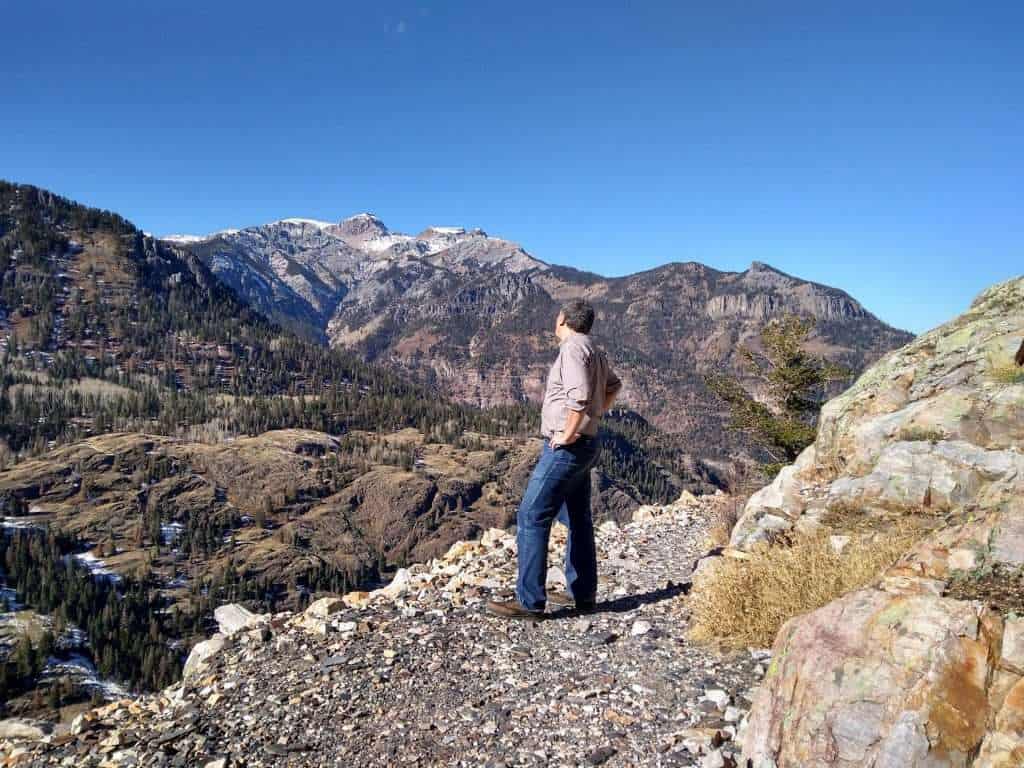
Having been born and raised in Colorado, one of the many things I learned while growing up was the names and locations of the fifty-eight mountain peaks that tower above fourteen thousand feet. I also learned to have a deep reverence, respect, and caution when climbing anyone of the “fourteeners” where a person often starts out in the warm sunshine, moves into the clouds, tramps through the rain, plods through sleet, and then struggles through a snow storm in the middle of July. From our own experiences on mountains today is easy to understand why from the beginning of the human race, people of all religions have gone to the top of mountain to ritualize their spirituality and then return from the top of the mountain to put their spirituality into practice.
For example, the Inca Indians of South America made their human sacrifices on the top of the Andes mountains, but then came back down to plant their crops and find out if their sacrifices were accepted. The Aztec Indians of Central America divided their world into the lower regions for humans and the upper regions for the gods. What took place in the heavens mirrored what took place on earth.
In the Bible there are stories where spiritual things happened on a mountain top and what is spiritual on the mountain top is brought down from the mountain top. Moses went up on Mount Sinai to receive the Ten Commandments and the Ten Commandments were brought back to us. Abraham went up a mountain called Moriah to sacrifice his son Isaac and came back to be the father of a chosen people. Noah’s ark landed on a mountain in Eastern Turkey and from the ark animals and people came down to populate the earth. Jesus went up a mountain to be tempted, to pray, to be transfigured, to be crucified, and finally to ascend into heaven.
But too often, I think we take our mountain top experiences too personally. We not only go to the mountain top alone but we leave our spiritual experience on top of the mountain when we come back down. Like the apostles, we stand on the mountain gazing up at the sky watching and waiting. We see this as a “significant pause” that belongs to us alone. Like the apostles we are afraid to share our “significant pause” in a culture where spirituality has been misconstrued as something exclusively personal and private concerning individual seekers or, at most, a specific group or religious institution. And how can our significant pause with its unique spiritual signs and symbols compete with the trademarks of designer clothes, luxury automobiles, and electronic devices that offer immediate gratification rather than inspiration and guidance in living a disciplined holy life?
As we prepare to celebrate Jesus sending us the Holy Spirit on Pentecost we ought not to forget the question that the two men dressed in white asked the Apostles in today’s first reading: “Why are you standing here looking up at the skies?” This is a rhetorical question. Its purpose is show the Apostles that there is a ministry to be planned for, a service to be done, and a mission to be accomplished. Gazing up into the heavens is not an option. In other words, on the mountain top, prayer is easy and talk is cheap, but going down from the mountain to do what we have prayed and talked about is the challenge.
Although the specific details of what the disciples did to respond to Jesus telling them to make disciples of all nations can be found in the Acts of the Apostles and in Paul’s letters, we have to look to own lives to decide on how we are going to respond to the call of Jesus before his departure.
Certainly, prayer alone and prayer together, like the disciples, is a good starting point. But we have to remember that we, like the disciples, have no power of our own. We possess no power and we cannot generate any power for ourselves. We have no claim and no cause for self-congratulations in the ministry we do. The power given to us to have the energy, courage, perseverance, and imagination, to offer our resources is given as a result of Jesus’ resurrection, his return to God, and his sending the Holy Spirit to us. So we never can begin our ministry with the questions, “What have we done?” or “What are we to do?” Our ministry must always start with the question, “What is the Holy Spirit calling us to do today?” When we ask this question, we stop looking up into the heavens and we continue the ministry we are doing as well as beginning the ministry we are yet to do because heaven is joined to earth.
On April 1, we began reflecting on the community of the Church of St. Matthew who rose from the 1968 fire to begin again. We met the Board of Trustees and members of the Parish Pastoral Council, some of who have labored beyond their terms and in additional ways to both maintain and advance the parish. We reviewed the parish constitution and bylaws which provide the means, like establishing standing committees and task forces, to address the physical needs of the campus and the spiritual needs of our community. On Pentecost, the Church of St. Matthew’s recommendations to de-cluster from the Churches of St. Michael and Our Lady of Guadalupe given to the Archdiocese Strategic Planning Task Force in 2015 will be in the bulletin for our prayerful consideration.
Come Holy Spirit, inspire and direct us to blaze forward!
Fr. Bob Kelly

Photo by Brian Schletty: Bear Creek Trail along Million Dollar Highway, near Ouray, Colorado.

Leave a Comment