Advancing the call of the Second Vatican Council to “reform” the Church, Pope Francis has made clear that “Christ calls the pilgrim church to perennial reform”.
The Church always needs to be renewed because its members are all sinners and in need of conversion; and any permanent reform of the Church calls for the conversion of the “whole Church.”
In reflecting on the unhealthy elements of the Church that cry out for reform, Pope Francis lists: excessive planning and functionalism, loss of community among the members of the Church, a clergy enmeshed in extravagant garments, honors, careerism and opportunism, and membership in closed circles.
Pope Francis desires that “the Church’s customs, ways of doing things, times and schedules, language and structures be suitably channeled for the evangelization of today’s world rather than for her self-preservation.” The Church is called to move out of herself and be drawn to the peripheries.
Reforms are carried out from below, based on decisions and processes in the local churches. The “church” that you and I know best is the local church, the parish and diocese. The manner in which faith is lived in the local church can either enhance the work of evangelization or destroy any effort at evangelization. So, it is necessary to “abandon” outdated structures that no longer support the transmission of faith.
The Latin American Church has wrestled with the effort to reform for many years, beginning with the work of Medellín, Colombia in 1968; a Latin American Bishops Conference was held as a follow up to the Second Vatican Council.
The model of Church that emerged from the work of Medellín is a “church in which the laity must participate in discernment, decision-making, planning and implementation.”
In my years as pastor of Saint Matthew, a parish council plan was implemented in which the Council would be a decision-making body charged with planning and implementation. The pastor could not act without the participation of the council, and the council could not act without the participation of the pastor. At Saint Matthew, we drew our model from the work of the Latin American Church.
Fr. Steve Adrian
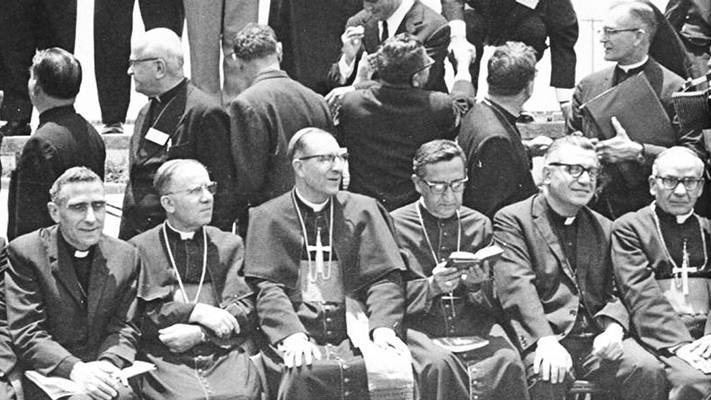
Between August 24 and September 6, 1968, 247 bishops from Latin America, together with Pope Paul VI, gathered in Medellín, Colombia to reflect on the role of the Church in Latin America.

Leave a Comment