
Icon of Saint Matthew in the Basilica of Saint Apollinaris, Ravenna. Source: Wikimedia Foundation.
We find the bits and pieces of the story of our patron saint, Matthew, in Chapter 9 of the Gospel and we find him listed as “Matthew, the tax collector” in Chapter 10 where the Twelve Apostles are listed. In Hebrew, the name “Matthew” means “gift of God.”
The city of Capernaum, Matthew’s place of work, was built on the side of the Lake of Galilee and had about 1,500 residents. Among those residents were Peter and his family. Peter, Andrew, James, and John were fishermen in Capernaum. Jesus “adopted” Capernaum as his city, “leaving Nazareth he went and lived in Capernaum.” (Matthew 4:13)
Capernaum enjoyed a privileged economic position, its resources being fishing, agriculture, industry, and trade. Capernaum was commercially linked in a prominent way with the northern regions, i.e. upper Galilee, Golan, Syria, Phoenicia, Asia Minor and Cyprus. The presence of a detachment of Roman soldiers at Capernaum (Lc 7: 1-10; Mt 8: 5-13) stresses the importance of the city as a crossroad for many travelers leaving and entering the region.
This cosmopolitan community attracted many visitors and business people. It was a center of not only commerce, but also education and the arts. People from other areas needed to change their currency into local currency to do business – this was one of the functions of the “money changer” and “tax collector.” Capernaum was a border town provided with a customs agent (Mc 2:13-15) along the main imperial highway leading to Damascus.
Custom agents also served as tax collectors and money changers and were considered non-observant Jews because they made their living dealing in and touching foreign money, and thus rendered themselves “impure.”
Matthew did this work and had a tax booth on this major road on the outskirts of the city. It was at this spot that Jesus saw Matthew and said to him, “Follow me.” Matthew immediately left his custom station and followed Jesus.
The ministry of Jesus announces the inclusive love of God – and thus he is often in the presence of “tax collectors and sinners” as a way of dramatizing this inclusive love and acceptance. Jesus dines at the table of Matthew and among his invited friends – tax collectors – to the chagrin of the Pharisees.
It is ironic that this outcast and “impure” Jew should be named “gift of God.” This name is but another way to teach that the inclusive love of God touches all – even those we might regard as disposable or unimportant.
May we see in our patron the invitation to be witnesses to the universal love and mercy of God.
Father Stephen Adrian
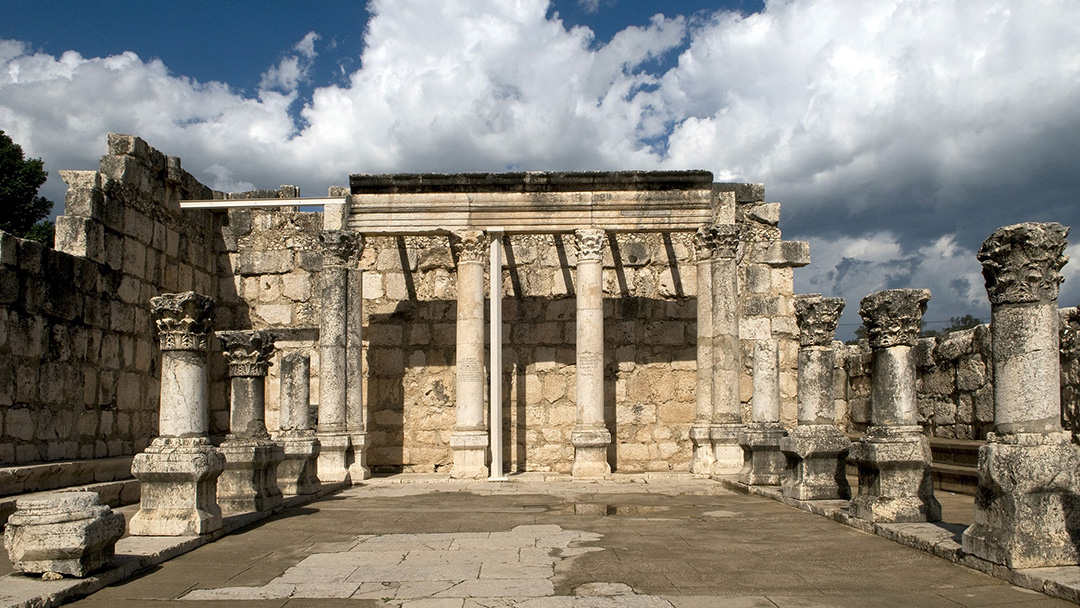
Ruins of the ancient Great Synagogue at Capernaum (or Kfar Nahum) on the shore of the Lake of Galilee, Northern Israel. Source: Wikimedia Foundation.

Leave a Comment